
 Blog
Blog - After the results
Pregnancy advice overload: How to decide what to trust (and what to ignore)

Nothing in this article is or should be construed as medical advice; for any medical questions, consult your healthcare professional.
In this article
- Why pregnancy advice feels so overwhelming
- The pregnancy advice hierarchy: What to trust (and in what order)
- When to immediately consult your provider
- Red flags: Pregnancy advice to question or ignore
- Practical strategies for filtering the best pregnancy advice
- You’re allowed to trust yourself when it comes to pregnancy advice
You share one small pregnancy symptom with your family, and it opens a floodgate of warnings and advice — some comforting, some contradictory and some concerning.
Pregnancy advice overload is real, and it comes from everywhere. Most of it is shared with good intentions. But that doesn’t mean it’s always helpful, or even accurate. So how do you know which pregnancy advice to trust?
If you’re feeling the pregnancy pressure, you’re not alone. Conflicting pregnancy advice can increase pregnancy anxiety, especially when everything is framed as urgent or critical. When you’re already navigating body changes, uncertainty and big decisions about pregnancy choices, the extra noise can feel overwhelming.
In this guide, we’ll give you practical strategies to help you sort through pregnancy advice, decide what to trust and ignore what doesn’t serve you with confidence.
Why pregnancy advice feels so overwhelming
Pregnancy advice can feel overwhelming because it’s coming from everywhere at once — healthcare providers, apps, books, family, social media and even strangers — and those sources don’t always agree. At the same time, pregnancy guidance is often framed in high-stakes or worst-case terms (“never do this,” “always avoid that”), which can increase stress instead of helping you make informed choices.
In reality, every pregnancy is different, and what worked for someone else may not apply to your health, circumstances or values. Pregnancy itself can also make information overload feel heavier: Research shows being pregnant is associated with higher rates of stress and anxiety, plus the hormonal shifts and sleep disruption it often brings can reduce mental bandwidth and emotional resilience.1,2
If all of this feels overwhelming, that’s completely normal. Pregnancy advice overload happens — but you can sort through what you hear and decide what deserves your attention. Let’s explore some strategies to help separate helpful guidance from background noise.
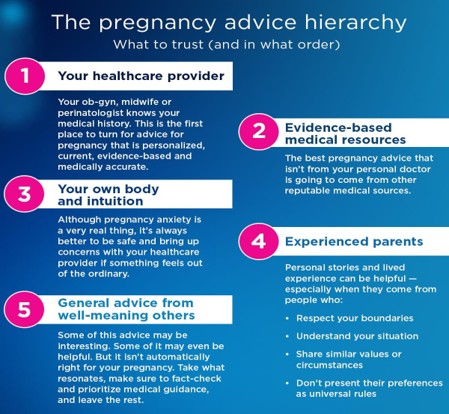
The pregnancy advice hierarchy: What to trust (and in what order)
Ranked from Tier 1 (trust these sources first) to Tier 5 (take what resonates, leave the rest), this hierarchy is designed to help you quickly categorize the advice you receive and decide how much weight to give it.
- Tier 1: Your healthcare provider
Your ob-gyn, midwife or perinatologist knows your medical history. This is the first place to turn for advice for pregnancy that is personalized, current, evidence-based and medically accurate. If you receive advice for pregnancy from other sources that conflicts with your provider’s guidance, bring it to your next appointment.
(Note: Your healthcare provider should take your concerns seriously and give you clear answers. If your concerns are dismissed repeatedly, seeking a second opinion is not only reasonable, but part of your rights as a patient.)
Tier 2: Evidence-based medical resources
The best pregnancy advice that isn’t from your personal doctor is going to come from other reputable medical sources. Look for pregnancy guidance from trustworthy, evidence-based medical organizations such as:- American College of Obstetricians and Gynecologists (ACOG)
- American Society for Reproductive Medicine (ASRM)
- March of Dimes
These sources are more likely to reflect current research, clinical consensus and medically reviewed guidance.
✅ Green flags to look for when assessing a source:- References or cited research
- Named medical reviewers or advisory boards
- Recently updated/reviewed content
- Neutral, nonsensational tone
Tier 3: Your own body and intuition
Although pregnancy anxiety is a very real thing, it’s always better to be safe and bring up concerns with your healthcare provider. You know your body (and your experience in it) better than anyone else.- If something feels off, bring it up with your healthcare provider.
- If something feels wrong for you, pause and ask questions.
- If something feels reassuring or supportive, that matters too.
Tier 4: Experienced parents (who know your context)
Personal stories and lived experience can be helpful — especially when they come from people who:- Respect your boundaries
- Understand your situation
- Share similar values or circumstances
- Don’t present their preferences as universal rules
These perspectives can offer insight and reassurance, and make you feel less alone when navigating pregnancy. Remember though: They’re still individual experiences, not medical guidance.
Tier 5: General advice from well-meaning others
This tier encompasses much of the noise out there in the world that can feel overwhelming, including:- Social media anecdotes
- Unsolicited advice from strangers
- Generational sayings
- Broad cultural beliefs
Some of this advice may be interesting. Some of it may even be helpful. But it isn’t automatically right for your pregnancy. Take what resonates, make sure to fact-check and prioritize medical guidance, and leave the rest.
When to immediately consult your provider
Always defer to your healthcare professional if advice conflicts with medical guidance about:
- Medications or supplements
- Warning signs or symptoms
- Screening tests
- Medical procedures
- Sudden health changes
Red flags: Pregnancy advice to question or ignore
🚩 Fear- or shame-based language
Be cautious of advice that relies on fear, guilt or pressure, such as:
- “If you don’t do this, you’re harming your baby”
- “Good mothers always…”
- Catastrophizing
🚩 Outdated pregnancy advice
Anything that contradicts current medical evidence. Examples include older blanket rules around:
- Sleeping positions3
- All fish avoidance4
- All soft cheese avoidance4
- Zero caffeine policies4
Guidelines evolve as research improves. When in doubt, check current evidence-based medical sources.
🚩 Pseudoscience or advice that conflicts with medical guidance
Be wary of:
- Supplement megadoses
- Detox claims
- Advice to skip medical care
- “Toxin-free” fear marketing
“Natural” does not automatically mean safe in pregnancy, and decisions about treatments or remedies should always be discussed with your healthcare provider. And definitely do not skip appointments or routine medical care.
🚩 Advice that crosses personal boundaries
You are allowed to decline advice or behaviors that makes you uncomfortable, including:
- Body commentary
- Belly touching
- Food policing
- Birth plan pressure
- Feeding philosophy debates
🚩 Advice that comes with a sales pitch
Be cautious when pregnancy pressure is used to sell:
- Multi-level marketing (MLM) products
- Supplements
- Courses
- “Essential” pregnancy systems
Remember: You don’t owe anyone justification for declining unwanted advice during pregnancy.
These are all complete sentences:
- “That’s not what works for me.”
- “I’ll discuss it with my doctor.”
- “I’m not making that decision right now.”
Practical strategies for filtering the best pregnancy advice
Advice vs. pressure
Advice offers information and options. Pressure pushes urgency, guilt or fear — often without context or evidence. These strategies can help you tell the difference.
1. The three-question filter
When you receive pregnancy advice, ask:
- Is this advice grounded in information from a credible medical source?
If no, tread lightly. - Does this apply to my specific pregnancy?
Context matters — your health history, risk factors and values are unique. - Does this align with my provider’s guidance and my values?
If you’re unsure, bring it to your healthcare provider.
If advice fails two out of the three, you can most likely set it aside.
2. Limit your information inputs
- Choose 1–2 trusted pregnancy resources.
- Follow evidence-based social media accounts.
- Set time limits on browsing pregnancy forums or groups.
- Unfollow or mute accounts that increase anxiety.
- Take social media breaks when needed.
3. Curate what you let in
Unsolicited advice is common — and often exhausting. Try guiding the people in your life toward the type of support you actually want. Creating family boundaries (and friend boundaries) during pregnancy can help limit advice that increases stress or self-doubt. You can gently redirect conversations by saying:
- “I’m not looking for advice on that — but I’d love encouragement.”
- “Help with meals or errands is always appreciated, but I’m not looking for extra opinions right now.”
4. Develop response scripts for setting boundaries
For well-meaning advice, try saying:
- “Thanks — my doctor and I have a plan we’re comfortable with.”
- “I appreciate you sharing your experience.”
For unwanted advice, having responses at the ready can help you feel confident in the moment:
- “I’m not comfortable discussing that right now.”
- “My medical decisions are between me and my doctor.”
5. Know when to actually seek more advice
Seeking advice is different from receiving pressure. Actively seek guidance when:
- You’re experiencing symptoms your provider should know about
- You’re feeling more anxious or overwhelmed than what feels typical for you
- You need practical support (childcare, maternity leave, logistics)
- You want to understand evidence-based options for birth, feeding or care
- You need mental health support
- You’re facing a medical decision and want to understand your choices
You’re allowed to trust yourself when it comes to pregnancy advice
You are navigating one of the most advice-heavy seasons of life. Feeling overwhelmed is normal. Your healthcare provider, your values and your lived experience are your strongest guides.
Trust the process. Each choice you research, question and consider helps you build confidence in making decisions for yourself and your baby. There’s rarely one “right” answer — just the right answer for you and your baby.
Related Articles
Sources
- Schetter CD, Tanner L. Anxiety, depression and stress in pregnancy: Implications for mothers, children, research, and practice. Curr Opin Psychiatry. 2012;25(2):141–148. Accessed March 16, 2026. https://pmc.ncbi.nlm.nih.gov/articles/PMC4447112/
- Weimar F, Kogler L, Rehbein E, Morawetz C, Sundstrom-Poromaa I, Skalkidou A, Derntl B. Neural emotion regulation during pregnancy: An fMRI study investigating a transdiagnostic mental health factor in healthy first-time pregnancy women. Imaging Neurosci (Camb). 2025;3:imag_a_00529. Accessed March 16, 2026. https://pmc.ncbi.nlm.nih.gov/articles/PMC12319865/
- NIH. Science Update: Sleeping position during early and mid pregnancy does not affect risk of complications, NIH-funded study suggests. Published September 20, 2019. Accessed March 16, 2026. https://www.nichd.nih.gov/newsroom/news/092019-pregnancy-sleep-position
- CDC. Safer Food Choices for Pregnant Women. Published January 31, 2025. Accessed March 16, 2026. https://www.cdc.gov/food-safety/foods/pregnant-women.html
OASH | Office on Women’s Health. Staying healthy and safe. Updated September 26, 2025. Accessed March 16, 2026. https://womenshealth.gov/pregnancy/youre-pregnant-now-what/staying-healthy-and-safe